
No products added!

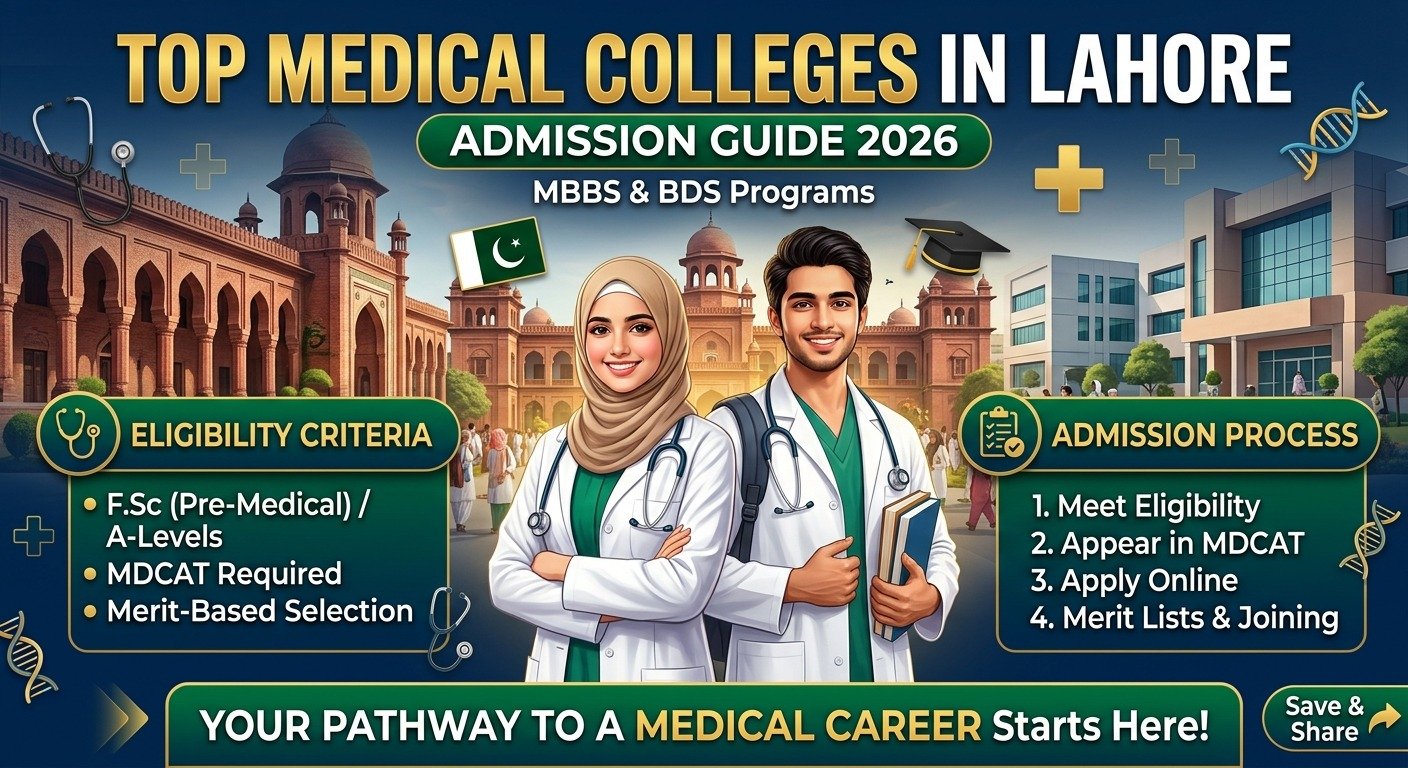
Choosing the right medical college is one of the biggest decisions a student in Pakistan will ever make. With hundreds of institutes and thousands of applicants competing for limited seats every year, it’s easy to feel overwhelmed. Whether you’re searching for the top medical colleges in Lahore, comparing the best medical universities in Islamabad, or exploring options in Karachi, this guide breaks it all down — rankings, eligibility criteria, and everything in between.
At Hamari Taleem, we help students find the right institute, understand fee structures, and even apply for admission online — all from one platform. Let’s dive into the details.
Why Lahore Is a Hub for Medical Education
Lahore has long been considered the educational capital of Pakistan, and this holds especially true for medical education. The city is home to some of the best medical universities in Lahore, ranging from century-old public institutions to modern, well-equipped private colleges. If you’re looking for the best colleges in Lahore for MBBS or BDS, you’ll find a healthy mix of affordable government seats and private options with flexible admission criteria.
Top Medical Colleges in Lahore (Public Sector)
Government medical colleges in Lahore are highly sought after because of their low fees, strong clinical exposure, and reputable faculty. Admission is merit-based and highly competitive.
- King Edward Medical University (KEMU) — One of South Asia’s oldest medical institutions, dating back to 1860. Widely regarded as the No. 1 medical college in Lahore, KEMU is known for its rigorous academics and affiliation with Mayo Hospital.
- Allama Iqbal Medical College (AIMC) — Established in 1975 and affiliated with Jinnah Hospital, AIMC is known for modern facilities and a strong research culture.
- Fatima Jinnah Medical University (FJMU) — Pakistan’s leading women-only medical university, with a long legacy of producing top female physicians.
- Services Institute of Medical Sciences (SIMS) — Affiliated with Services Hospital, offering excellent hands-on clinical training.
- Ameer-ud-Din Medical College (AMC/PGMI) — Linked with Lahore General Hospital, a solid public-sector choice.
- Shaikh Khalifa Bin Zayed Al-Nahyan Medical & Dental College — A newer but well-resourced public college in Lahore.
Top Medical Colleges in Lahore (Private Sector)
If you’re exploring best medical universities in Lahore in the private sector, here are some well-known names:
- CMH Lahore Medical College & Institute of Dentistry
- FMH College of Medicine & Dentistry
- Shalamar Medical & Dental College
- Lahore Medical & Dental College (LMDC)
- Rashid Latif Medical College
- Sharif Medical & Dental College
- Central Park Medical College
- Avicenna Medical College
- Continental Medical College
- Al-Aleem Medical College
Private colleges typically have higher fees but offer more admission flexibility, modern infrastructure, and additional intake through NUMS-affiliated seats.
Best Medical Universities in Islamabad
Islamabad and neighboring Rawalpindi also host some of the top medical universities in Pakistan, particularly popular among students who prefer NUMS-affiliated institutions:
- Army Medical College (AMC), Rawalpindi — Affiliated with NUMS, known for its disciplined academic environment and strong postgraduate programs.
- Federal Medical & Dental College (FMDC), Islamabad — A top public-sector option in the federal capital.
- Shifa College of Medicine — Part of Shifa Tameer-e-Millat University, recognized for its research-driven curriculum and teaching hospital.
- Foundation University Medical College — Known for modern facilities and strong academic standards.
- NUST School of Health Sciences — A newer addition, focused on innovation and medical technology.
- Fazaia Medical College — Operated by Air University, offering a comprehensive MBBS program.
- Rawalpindi Medical University (RMU) — A well-established public medical university with wide clinical exposure.
Best Medical Universities in Karachi
Karachi remains home to some of the best medical universities in Pakistan overall, combining strong academics with international recognition:
- Aga Khan University (AKU) — Frequently ranked as Pakistan’s top medical university by the HEC, known for its research output and state-of-the-art hospital.
- Dow University of Health Sciences (DUHS) — One of the oldest and most respected public medical universities, affiliated with Civil Hospital Karachi.
- Jinnah Sindh Medical University (JSMU) — A leading public institution with several affiliated colleges.
- Ziauddin University — A well-known private medical university with modern teaching hospitals.
- Baqai Medical University — A long-established private option in Karachi.
- Karachi Metropolitan University (formerly Karachi Medical & Dental College) — A respected public-sector college.
MBBS/BDS Eligibility Criteria in Pakistan
Before applying to any of the above institutes, make sure you meet the basic eligibility criteria set by the Pakistan Medical & Dental Council (PMDC):
- Academic qualification: FSc Pre-Medical, A-Levels, or an equivalent HSSC qualification with Biology and Chemistry as compulsory subjects (plus Physics or Mathematics).
- Minimum marks: Most recent PMDC guidance requires at least 65% marks in FSc/HSSC (Pre-Medical), along with a strong Matric/SSC score. Requirements can vary slightly by year and institution, so always check the latest notification before applying.
- MDCAT requirement: Candidates must pass the MDCAT (Medical & Dental College Admission Test) with a minimum score — generally 55% for MBBS and 50% for BDS — though some universities set their own, higher thresholds.
- A-Level/O-Level students: Must obtain an IBCC equivalence certificate before registering for MDCAT or applying to any medical college.
- Domicile requirement: Public-sector seats are usually allocated based on the province of your domicile.
- Valid CNIC/B-Form: Required for registration; a Juvenile Registration Certificate (JRC) is required for applicants under 18.
Note: Eligibility rules are updated by PMDC almost every year, so it’s important to confirm current requirements directly with your chosen university or through Hamari Taleem before applying.
How to Choose the Right Medical College
With so many best colleges in Lahore, Islamabad, and Karachi to choose from, here’s what to actually compare:
- Affiliation and recognition — Confirm the college is recognized by PMDC and, if applicable, affiliated with NUMS or a public university.
- Teaching hospital — A strong attached hospital means better clinical exposure during your MBBS/BDS years.
- Fee structure — Public colleges are significantly cheaper than private ones; compare total 5-year costs, not just first-year fees.
- Location and hostel facilities — Especially important for out-of-city students.
- Merit list history — Check previous years’ closing merit to gauge your chances realistically.
Why Use Hamari Taleem to Apply
Instead of visiting multiple campuses and comparing scattered information, Hamari Taleem brings everything together in one place:
✅ Search medical colleges and universities by city, fee, or program ✅ Compare eligibility criteria and merit requirements instantly ✅ Apply for admission online without office visits ✅ Get exclusive discounts on admission through our platform
👉 Start exploring now at www.hamaritaleem.com
Frequently Asked Questions (FAQs)
Q1: Which is the best medical college in Lahore? King Edward Medical University (KEMU) is widely regarded as the top medical college in Lahore due to its legacy, low fees, and strong clinical training, though Allama Iqbal Medical College and Fatima Jinnah Medical University are also top contenders.
Q2: What percentage is required for MBBS admission in Pakistan? Most recent guidance requires a minimum of 65% marks in FSc Pre-Medical (or equivalent) along with a passing MDCAT score, though exact percentages can vary by year — always verify with the current PMDC notification.
Q3: Is MDCAT compulsory for all medical colleges in Pakistan? Yes, MDCAT is mandatory for admission to any MBBS or BDS program in Pakistan, whether public or private, in Lahore, Islamabad, Karachi, or elsewhere.
Q4: Which is better — Aga Khan University or Dow University for MBBS? Both are excellent. Aga Khan University is a private institution known for research and international recognition, while Dow University of Health Sciences is a public university offering high-quality education at a much lower cost.
Q5: Can A-Level students apply for MBBS in Pakistan? Yes, A-Level students can apply, provided they obtain an IBCC equivalence certificate converting their grades to the FSc/HSSC system before registering for MDCAT.
Q6: How can I compare fees of different medical colleges easily? You can use Hamari Taleem’s platform to compare fee structures, eligibility criteria, and admission details of multiple medical colleges in Lahore, Islamabad, and Karachi side by side.
Q7: Are private medical colleges recognized by PMDC? Yes, as long as they appear on the official PMDC-recognized list. Always verify a private college’s accreditation status before applying.

About Author Hamari Taleem
Roshan Pakistan Ka Mustaqbil!